Health systems are experiencing the greatest pressure at the top as the market for executives is limited…
While the health care industry has seen modest financial recovery, organizations continue to operate in a highly dynamic environment shaped by regional operating margin variability, federal policy shifts, and rising cost pressures. These factors are directly influencing executive compensation levels, performance priorities, and talent strategies as health systems work to balance financial resilience with leadership continuity.
How are organizations addressing this? We have the latest executive compensation insights!
Explore strategies and approaches with highlights from SullivanCotter’s 2025 Health Care Management and Executive Compensation Survey – which includes data from more than 3,300 organizations on nearly 48,000 incumbents.
Dive deeper into these industry-leading benchmarks to see how health systems are prioritizing financial sustainability, seeking new opportunities for growth, redesigning their operating models, and looking to optimize their resources.
Don’t Forget: the 2026 Survey is Open for Participation!
Secure exclusive pricing and benefits when you submit data to this year’s survey.
Need a quick summary?
Pay Actions and Trends
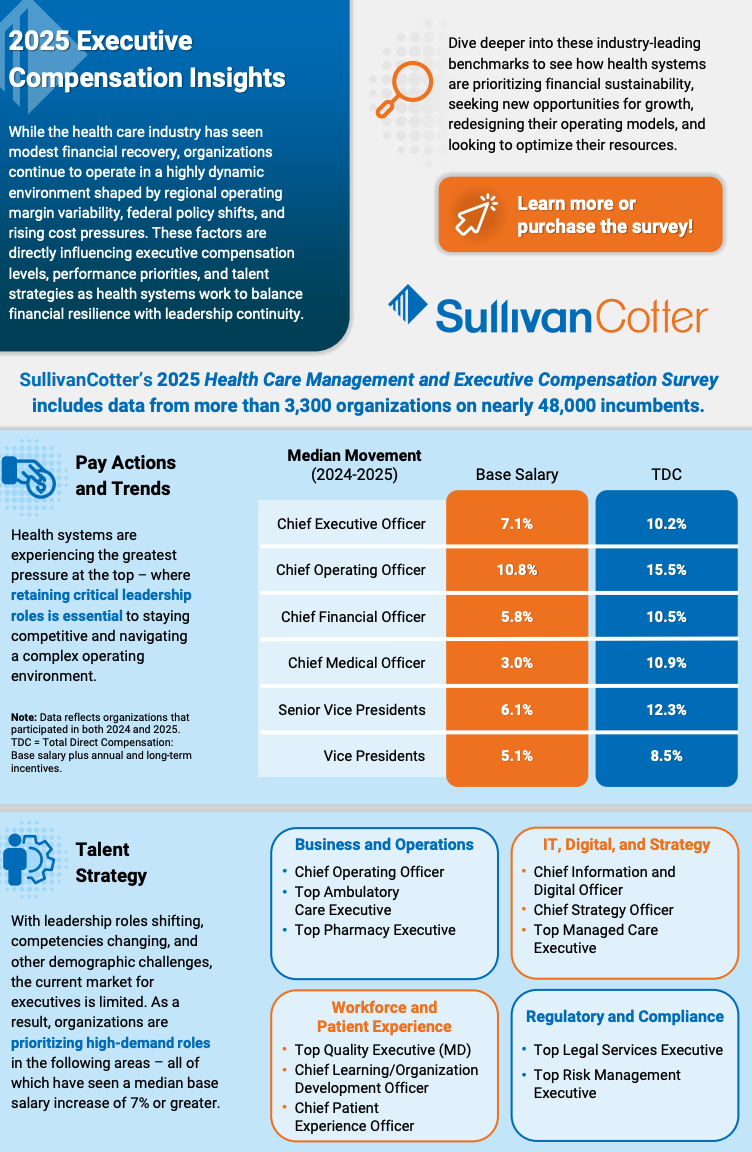
Health systems are experiencing the greatest pressure at the top – where retaining critical leadership roles is essential to staying competitive and navigating a complex operating environment.
- From 2024-2025, Chief Operating Officers say the largest increases in median base salary at 10.8%.
- This is followed closely by Chief Executive Officers at 7.1%.
- Senior Vice Presidents, however, saw the most growth in total direct compensation, which is equal to base salary plus annual and long-term incentives, at 12.3%.
Talent Strategy
- With leadership roles shifting, competencies changing, and other demographic challenges, the current market for executives is limited.
- As a result, organizations are prioritizing high-demand roles in the following areas – all of which have seen a median base salary increase of 7% or greater.
- High-demand roles include those associated with Business and Operations, IT, Digital and Strategy, Workforce and Patient Experience, and Regulatory and Compliance.
Evolving Long-Term Incentive Measures and Practices
- Incentive plan designs must adapt to a dynamic operating environment in which health systems are prioritizing consumer experience, advancing population health, and accelerating digital and AI adoption.
- At the same time, rising cost pressures and funding reductions heighten the need for efficiency and affordability, requiring incentive structures that align leadership performance with these evolving strategic imperatives.
- Strategic Initiatives continues to be the measure with the largest increase in prevalence due to a heavy post-COVID focus. It has grown by 12% since 2022.
- In 2025, Financial measures remain the most prevalent at 75%, followed by Growth (47%), Quality (43%), and Strategic Initiatives (40%).
Organization Design and Workforce Analytics
- Even though salaries are increasing, the executive workforce experienced lower annualized total salary cost and headcount growth than any other career level.
- This reflects design in action: balancing efficiency with the need to invest in top talent. It shows that organizations are focused on optimizing spans of control, reducing layers and clarifying job levels, and being disciplined about executive and leadership headcount.
Learn more about our Health Care Management and Executive Compensation Survey!
For more than 30 years, this survey has provided data-driven benchmarks on executive and management compensation to help organizations make informed decisions on pay, incentive program design, and more.
- Data from more than 3,300 organizations on nearly 48,000 individuals
- Inclusion of approximately 350 reported jobs
- Base salary, total cash compensation, and total direct compensation
- Insight into annual and long-term incentive plan design, including performance measures, award opportunities, and payouts
- National compensation data reported by organization type and size with regional and sub-regional breakouts for subsidiary hospitals
- Regression equations by organization type