

Enhancing Strategic Alignment and Financial Sustainability in Health Systems
Health systems across the United States have long relied on Professional Services Agreements (PSAs) with large independent physician groups to secure critical clinical coverage for their communities. These keystone arrangements, often evergreen in nature, were established to ensure service continuity and do remain foundational to service line strategy today. However, most were developed without built-in mechanisms to account for the rapidly evolving health care landscape.
Many health systems find themselves locked into cost-intensive arrangements that lack strategic alignment with evolving enterprise goals. Fear of losing coverage, the prohibitive cost of building services from the ground up, or having to outsource to private equity-backed organizations keeps systems locked into a cycle of escalating costs without commensurate improvements in performance or outcomes.
This article examines the multifaceted challenges facing health systems reliant upon keystone PSAs and provides a comprehensive framework to modernize these arrangements – ensuring strategic alignment, financial sustainability, and operational excellence.
With a mindset of “set-it and forget it,” unattended keystone PSAs can devolve into high-cost, low accountability arrangements that are misaligned with modern health care strategy, market economics, and care delivery models.
Strategic Challenges
Misalignment with Enterprise Goals: PSAs are operating as transactional coverage tools instead of strategic alignment vehicles. Even when systems recognize misalignment, they lack the leverage or capability to act. While striving for financial sustainability, addressing clinical workforce challenges, pursuing value-based care, population health management, and integrated delivery models have become strategic imperatives, many legacy arrangements remain focused solely on fee-for-service coverage.
Limited Negotiation Leverage: Health systems often believe they lack sufficient negotiating leverage due to dependency on existing coverage, mutual buy-in from physician groups to modernize arrangements, skilled internal resources with expertise in restructuring complex physician arrangements, and sustainable alternatives to
current coverage options.
Obsolete Foundational Context: What made sense 10-20 years ago no longer serves either party effectively. Market dynamics, reimbursement models, regulatory requirements, and patient expectations have evolved.
Financial Challenges
Keystone PSAs incentivize volume and presence, not value and efficiency. Most tie financial support exclusively to coverage obligations rather than to measurable performance metrics as described above.
Health systems and their independent physician group partners are also facing a perfect storm of financial pressures. They are experiencing declining payer reimbursement rates while simultaneously managing continued escalation in physician compensation expectations and new generational pressures to moderate workplace demands – resulting in downward trends in productivity (wRVUs). Additionally, market pressures to remain competitive in recruitment further compound these financial challenges.
Many of these arrangements include year-over-year increases in overhead costs that can exceed inflation. These escalations frequently occur without rigorous evaluation of cost appropriateness or transparency into the underlying drivers. In many cases, there is limited benchmarking against peer organizations to validate whether expenses are reasonable or competitive.
Operational Challenges
Even well-designed agreements fail if not executed or governed well. This can include unclear decision-making authority, insufficient representation or influence within the health system, lack of structured accountability mechanisms, and inadequate follow-through.
Systems are often challenged with limited resources for the ongoing management of these arrangements – including adequate tools and technology for monitoring performance, dedicated resources (FTEs) to manage complex arrangements, and timely, accurate data for decision-making.
Furthermore, many arrangements have undefined performance expectations. This includes metrics that aren’t contemporary and aligned across the parties, consequences for underperformance or rewards for overperformance, and insufficient communication of expectations to frontline providers.
Provider Resource Challenges
To further complicate matters, workforce instability increases costs while reducing performance predictability. Clinical labor shortages create persistent recruitment and retention challenges and an excessive reliance on expensive locum tenens coverage. An aging workforce also underscores the need for physician succession planning and for a better understanding of generational differences when it comes to work-life balance.
Additionally, the care models and leadership structures embedded into these keystone PSAs often lag modern clinical practice. Traditional physician-centric models persist, with minimal evolution toward team-based care, underutilization of Advanced Practice Providers (APPs), high costs, and missed opportunities for care model innovation.
There has also been a proliferation of administrative and leadership positions, disproportionate leadership costs relative to clinical delivery, and unclear leadership roles and responsibilities.
Leading Practices: A Comprehensive Modernization Framework
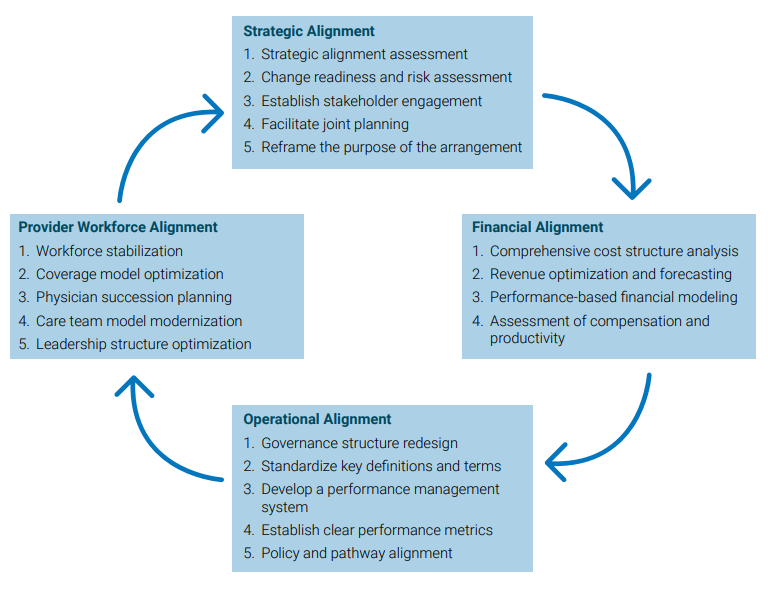
When thoughtfully redesigned, keystone PSAs can evolve from static coverage arrangements into dynamic, performance-oriented partnerships that advance both organizational strategy and clinical excellence. Modernized agreements create a shared framework for accountability by aligning incentives across health systems and physician groups while supporting adaptability in a rapidly changing health care environment.
This framework is grounded in leading practices and can be helpful when updating these arrangements (see the framework below).
Expected Outcomes
The following outcomes reflect what health systems can realistically achieve when modernization efforts are executed with discipline, transparency, and a commitment to long-term partnership.
These results collectively represent the shift from transactional relationships to strategically aligned, high-performing collaborations.
Strategic
Strategic Alignment: PSA fully supports health system enterprise goals and service line strategies
Partnership Foundation: Stronger relationships for greater ability to adapt to evolving needs
Competitive Advantage: Differentiated care delivery models that enhance market position
Financial
Financial Sustainability: Arrangement that is economically viable for both parties
Performance-Based Economics: Financial model tied to outcomes and value creation
Fair Market Value/Commercial Reasonableness: Arrangement that meets regulatory and compliance standards
Cost Optimization: Right-sized overhead and improved cost management
Operational
Effective Governance: Functioning joint governance with clear accountability
Performance Management: Robust infrastructure for ongoing arrangement management
Operational Excellence: Improved efficiency, quality, and outcomes
Data-Driven Decision-Making: Timely and accurate information supporting continuous improvement
Provider
Enhanced Engagement: Improved physician and APP satisfaction and retention
Workforce Stability: Reduced turnover and locum dependence
Care Model Innovation: Market-leading team-based care approaches
Performance Improvement: Measurable improvements in individual and group performance
Work-Life Balance: Staffing models that address generational expectations
Implementation Considerations
While the case for modernizing keystone PSAs is compelling, execution is inherently complex and requires a deliberate and structured approach. Successful transformation extends beyond contract redesign – it demands coordinated change across strategy, operations, governance, and stakeholder alignment.
The following phased approach can help organizations drive successful implementation, mitigate disruption, build trust, and ensure that redesigned agreements deliver lasting value for all parties involved.

Critical Success Factors
Organizations that successfully modernize keystone PSAs share a common set of enabling conditions that enable them to navigate complexity, preserve relationships, and deliver lasting results:
Executive Commitment: Sustained leadership engagement from health systems and their independent physician group partners
Adequate Resources: Sufficient time, expertise, and budget allocated
Balanced Approach: Attention to relationship dynamics as well as contractual terms
Change Management: Proactive management of organizational and cultural change, with recognition that meaningful progress takes time and requires open communication and mutual commitment
External Expertise: Engagement of specialized consultants where internal capacity and expertise are limited, and when preserving the relationship with the group through data and experience-driven negotiation support is meaningful
Conclusion
Modernizing keystone PSAs presents both significant challenges and substantial opportunities for health systems. While the current state – characterized by escalating costs, operational inefficiencies and strategic misalignment – is unsustainable, a clear and achievable path forward exists through the disciplined application of leading practices.
Health systems that successfully update these agreements will create durable, high-performing and engaged partnerships capable of delivering high-quality, patient-centered care, improved financial sustainability and cost discipline, greater agility in value-based and population health models and meaningful strategic differentiation in a competitive market.[/vc_column_text][vc_separator sep_color=”” uncode_shortcode_id=”158689″][vc_column_text uncode_shortcode_id=”471773″]
Partnering with SullivanCotter
Ready to modernize your keystone PSAs and strengthen alignment across your health system?
SullivanCotter partners with organizations to redesign physician arrangements that improve financial sustainability, enhance operational performance and support long-term strategic goals in an evolving health care landscape.
Contact Us


