Organizational design has emerged as a critical lever of transformation in today’s dynamic health care environment.
Are your administrative functions structured to enable performance, efficiency, and sustainability?
Administrative functions – such as Finance, Human Resources (HR), Information Technology (IT), Legal, Marketing, and Supply Chain – play a crucial role in driving operational success. These enterprise-level services, while not directly clinical, are part of the infrastructure that enables frontline care delivery. Over the past several years, health systems have been adapting these functional areas to be more efficient and effective. This is where deploying the ideal mix of administrative function centralization and decentralization can play a pivotal role.
First, it’s important to define what this means:
Very few systems are completely centralized or decentralized in their deployment of resources. In fact, many are starting to embrace hybrid models tailored to the unique needs of their organizations. We’ll describe the rise of hybrid models later in this article.
Organizations with a higher degree of centralization are typically characterized by:
- Unified reporting to a single leader (e.g., CHRO, CFO) with clear governance and centralized decision-making
- Standardized processes across entities
- Common technology platforms for data management and performance tracking
Conversely, functions with a greater degree of decentralization may be locally led and governed with more autonomy at the business-unit or facility level – resulting in more process variance and possibly quicker decision-making. As such, larger health systems with multiple hospitals or care sites may have a greater opportunity to centralize compared to their smaller counterparts or single-hospital systems.
Why Structure Matters: The Case for Reassessment
Organizations with a higher degree of centralization are typically characterized by:The question is no longer whether to centralize or decentralize, but how to align organizational design with strategic intent. A shift in operating model – particularly how administrative functions are structured – can unlock performance, reduce costs, and enhance responsiveness.
According to SullivanCotter’s Workforce Metrics Benchmark Database, many systems have already undertaken some administration function centralization initiatives. This analysis looked at five critical administrative functions – HR, Finance, Marketing, IT, and Legal – and categorized organizations as ‘centralized’ when a larger majority of employees (greater than 70%) in each function report to the head of that function. While the data shows that HR is typically the most centralized function, few systems achieve full administrative function centralization across all shared services. What emerges is a landscape of hybrid models that combine centralized and decentralized components depending on functional needs and organizational complexity.
Your organization’s circumstances are unique, and it’s important to keep those in mind when evaluating the right framework and appropriate level of administrative function centralization. Lotis Blue, a leadership development and organizational design company, has a unique operating model framework that is purposefully neutral. This helps to guide health care organizations through diagnostic and design processes that are informed by behavioral science, stakeholder feedback, and comparative benchmarking.
Rather than default to centralization, the process asks:
- What strategic health care goals are driving the change?
- Where is health care value created—speed, innovation, access, quality, or cost?
- What does the data say about function performance and alignment?
- What health care structures enable better decision rights and governance?
By focusing on intentionality, the framework helps avoid the trap of simply “moving boxes” around on the org chart without addressing deeper structural and cultural misalignments.
One Size Doesn’t Fit All: The Rise Of Hybrid Health Care Models
For most organizations, the decision to centralize or decentralize health care systems is not a binary choice. It usually requires a more tailored solution that only hybrid models can provide. Administrative functions don’t all need to follow the same path.
For instance:
- Centers of Excellence centralize expert work (e.g., Total Rewards)
- Shared Services Hubs support high-volume, repeatable processes
- Local teams stay embedded to preserve agility and cultural alignment
Garrett Sheridan, CEO of Lotis Blue, notes that academic medical centers, for example, may pursue full integration — centralizing brand, leadership, and operations — while retaining certain decentralized clinical programs for strategic reasons.
That’s why it’s important to consider key design criteria specific to your health care organization. When redesigning your operating model, the following questions are critical:
- Are you over- or under-invested relative to peers?
- Is there duplication across business units?
- Are spans and layers aligned to decision speed and clarity?
- What is your appetite for standardization vs. flexibility?
- Does your health care technology infrastructure support shared workflows?
Before proceeding, however, it’s important to understand the benefits, pitfalls and common challenges to manage the relationship between change and risk. While a higher degree of administrative function centralization may offer measurable cost benefits, organizations should be wary of making sacrifices that may undermine clinical performance and outcomes. Making changes to an operating model purely to drive down cost by consolidating resources without evaluating implications for clinical efficiency and effectiveness can lead to unintended consequences that jeopardize the internal stakeholder service
experience and quality of care.
Data from SullivanCotter’s Workforce Metrics Benchmark Database highlights the following
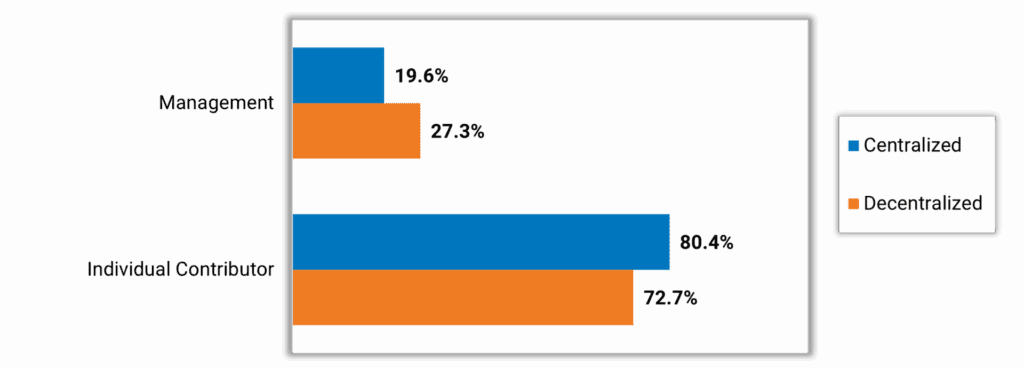
- A higher degree of administrative function centralization may enable a more streamlined management structure. Management teams in centralized structures are up to 28% smaller.
Percent of Total Workforce Headcount
Illustrative Example
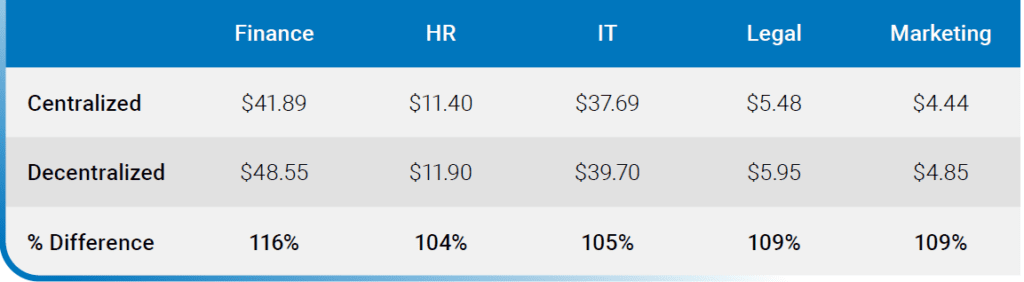
- Greater administrative function centralization may yield fewer FTEs and lower workforce cost. Finance workforce costs average $41.89 per $1,000 of payroll in centralized systems vs. $48.55 in decentralized systems – a 16% difference.
Workforce Cost
Per $1,000 of Organization Base Payroll
- As health system management structures become streamlined, spans of control widen as each executive, leader, or manager has more direct reports. Wide spans of control are a sign of management efficiency, tied to more autonomy and less bureaucracy.
Average Number of Direct Reports by Career State
Illustrative Example

However, there are other benefits realized by health systems that choose a more decentralized structure. Cost should not be the only consideration. Decentralization may promote responsiveness, innovation, and deeper alignment with community needs, particularly for rural or regionally distinct entities.
For example, consider an Onboarding sub-function that may have a small, centralized team focused on building capability, establishing standard processes, and providing governance and oversight – but has a larger team deployed in a decentralized manner to perform work and deliver services closer to internal stakeholders.
In circumstances like these, a more decentralized onboarding process may help to:
- Reduce bottlenecks by preventing slowdowns caused by over-reliance on central decisionmaking structures (critical in hiring to move quickly).
- Enhance customer focus through localized decision-making. This allows for more tailored approaches and greater responsiveness to specific clinician/patient/facility preferences.
- Increase innovation as teams close to the problem can experiment more freely, driving creativity and improving the quality of solutions to local problems.
Evaluating when a centralized or decentralized model is best is especially important during times of growth or change. A focused review is always appropriate when systems navigate mergers, acquisitions or strategic shifts. Careful consideration of the operating model is warranted when the size of the function is larger than comparators of a similar size and shape, processes vary by facility, by employee, or by patient population, or the growth of the function approaches or exceeds that of clinical staff.
Additionally, understanding where value is created can be instrumental in building the right operating model. Is the value of a new model derived from improved speed and responsiveness? Are there areas where enhanced internal stakeholder or patient focus is critical? Does the function need to create higher levels of innovation? Is creating greater cross-functional teams an important clinical value driver?
Structure Follows Strategy
Administrative function centralization is not a destination; it’s a design choice. Done well, it can unlock performance, reduce inefficiency, and enhance value. But success lies in choosing the right model based on strategy, not trends.
Combined, SullivanCotter’s industry-leading workforce data and benchmarks and Lotis Blue’s behavioral insights and operating model expertise help health systems navigate these decisions with clarity and confidence.