
APP turnover is more than an HR challenge – it’s an operational and financial reality.
Hadley Powless, MBA, PA-C, Consulting Manager
Joel Villegas, MBA, Consulting Manager
Lacey Buckler, DNP, ACNP-BC, FAANP, Principal
Introduction
The labor market has faced significant disruption over the past decade, most notably due to the COVID-19 pandemic. While many sectors have returned to prepandemic employment levels, health care continues to experience volatility driven by persistent staffing shortages and inflationary pressures.1 In response, many clinicians have exited the field entirely or transitioned away from direct patient care. Despite service demand stabilizing near pre-COVID levels, clinical staffing shortages remain widespread and have contributed to persistently high turnover rates.2
According to the 2024 National Health Care Retention & RN Staffing Report from NSI Nursing Solutions, the average hospital turnover rate stands at 20.7% with nursing-specific turnover at 18.4%.3 While these rates have declined from the post-pandemic peak of 26%–27%, they remain elevated compared to historical norms. Data from SullivanCotter’s 2025 Advanced Practice Provider Compensation and Productivity Survey indicates a median
external turnover rate of 8.6% among advanced practice providers (APPs), which includes physician assistants (PAs) and advanced practice registered nurses (APRNs).4 Certain specialties – such as emergency medicine and behavioral health – report turnover rates exceeding 14%.5 In comparison, the median voluntary turnover rate for physicians is approximately 7%.6
Turnover is an unfortunate reality in every industry, and its impact on cost, morale, and operational efficiency can be substantial. While physician and nurse turnover has been studied extensively, less attention has been paid to APPs. In 2020, SullivanCotter published a foundational report examining APP turnover, its associated costs, and the organizational factors that influence it. The report introduced a methodology for quantifying turnover-related expenses and offered a framework for organizations to assess and report these costs more effectively.
This research builds on that foundation by presenting updated cost data, analyzing key drivers of turnover and satisfaction, and outlining actionable strategies to improve APP engagement and retention. It includes insights and data compiled by SullivanCotter’s National APP Advisory Council (NAAC) – which consists of health care organizations with some of the nation’s largest and most advanced APP structures.
Additional insights were gathered from the following SullivanCotter survey reports:
• APP Compensation and Productivity
• APP Preferences
• APP Leadership and Organizational
Background
Advanced practice provider turnover has a measurable impact on both patient outcomes and provider engagement. A clear understanding of its root causes and financial implications is essential for developing effective organizational strategies.
SullivanCotter outlines a three-step approach to evaluate the economic impact of APP turnover:
- Identify organizational drivers contributing to turnover
- Quantify the associated costs
- Perform a comprehensive APP turnover cost analysis
Defining and Measuring APP Turnover
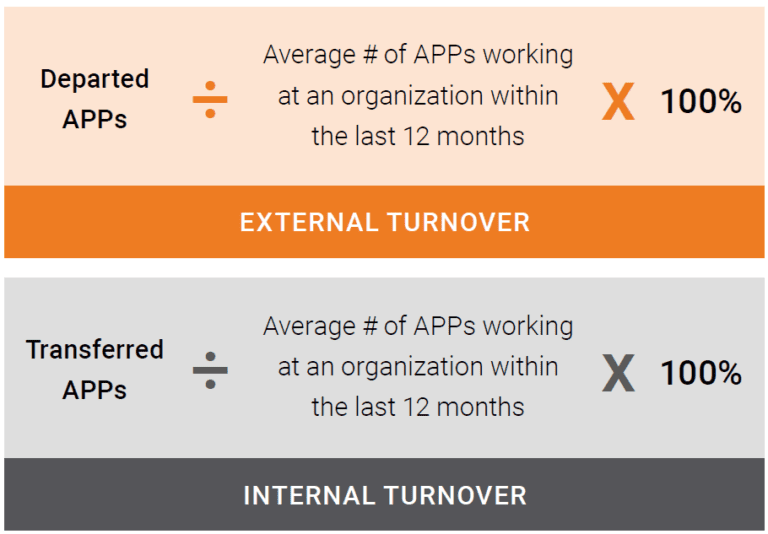
APP turnover can be categorized as either external or internal:
- External turnover is when an APP voluntarily leaves the organization to join another employer or exit the health care industry altogether. Often labeled as attrition or resignation, this type of turnover may be preventable through targeted retention efforts.
- Internal turnover or “churn” occurs when an APP transitions between departments or specialties within the same organization. This is more common among APPs than physicians due to the versatility of their licensure and certification, which allows for greater mobility across clinical areas.
Although internal turnover is a common challenge for many organizations, this analysis focuses exclusively on the cost of external APP turnover. While some internal movement supports retention by offering career growth, excessive shifts may signal concerns around equity, compensation, or culture. APP utilization influences both types of turnover. A comprehensive turnover analysis should include exit interviews, employee engagement surveys, utilization reviews, and benchmarking against industry standards to uncover root causes and inform retention strategies.
While understanding the types of turnover is essential, identifying the factors that influence an APP’s decision to stay or leave is equally critical. The following section explores key drivers of engagement and retention based on survey data.
Likelihood to Leave and/or Recommend the Organization
APP Engagement and Retention: Key Correlations
We analyzed data from SullivanCotter’s APP Preferences Survey, focusing on utilization, compensation, onboarding, and workplace dynamics. These insights were compared to APPs’ likelihood of leaving within 12 months and their willingness to recommend their organization. The analysis revealed strong correlations between specific workplace factors and retention outcomes.
Among APPs considering departure, the highest risk factors included:
- Minimal or no utilization
- Physicians not understanding the APP role
- Perceived lower compensation than peers
- Ineffective orientation
Methodology for Assessing Costs
Understanding the factors that drive APP turnover provides important context for evaluating its financial impact. To assess the cost of turnover, it is useful to focus on measurable factors with direct dollar amounts, such as recruitment, sign-on bonuses, and training. Indirect costs, including provider dissatisfaction, burnout, and lost patient revenue, are harder to quantify and can vary widely by organization.
The following elements represent the primary direct costs associated with APP turnover:
- Moving allowance
- Sign-on bonus
- Recruiter time (e.g., hours spent per APP recruited)
- Advertising
- Physician time for orientation and onboarding with a new APP (e.g., hours spent per APP oriented that took time away from patient care)
- APP time for orientation and onboarding (e.g., hours spent in non-billable orientation time)
- Background check/drug screen and licensure verification
Based on SullivanCotter’s 2024 APP Organizational and Leadership Survey Report and grounded in market research conducted with APP executives from organizations employing large APP workforces, the direct cost of turnover for a single APP ranges from $93,000 (25th percentile) to $147,500 (75th percentile), with a median of $120,000.5 These direct costs represent approximately 70% to 110% of the median APP salary.4
When factoring in indirect costs such as lost productivity, provider burnout, and patient care disruptions, the total estimated cost of APP turnover rises to $150,000 to $250,000, with a median of $187,500.5 This equates to 112% to 187% of the median APP salary.5 These estimates are consistent with data from both physician and nursing turnover research.3, 8, 9, 10

While the costs listed here are objective and quantifiable, advanced practice provider turnover costs can vary by organization – which is why each should conduct its own assessment. Elements of turnover should be clearly defined, easily measured or estimated, and agreed upon in advance. To accurately assess the total cost of APP turnover, organizations should have the following information available:
- Number of APPs working in your organization
- External turnover rate
- Headcount of the turnover rate (total number of APPs multiplied by the turnover rate)
- Factors driving turnover (consider exit interviews and/or engagement surveys)
Factors that Enhance APP Job Satisfaction
While understanding the cost of APP turnover is essential, addressing the factors that influence turnover and drive job satisfaction is key to improving retention. As part of SullivanCotter’s APP Preferences Survey, APPs were also
asked what their employers could do to enhance their work experience. Their responses revealed consistent themes that strongly influence engagement, motivation, and long-term commitment.
Analysis of the survey data identified several critical drivers of satisfaction. The top three motivators were:
- Work-life balance, including flexible scheduling (73%)7
- Competitive compensation (68%)7
- Collegial relationships with other clinicians (46%)7
Additional factors that contribute to APP engagement include:
- Competitive compensation and benefits
- Recognition of professional expertise and value
- Opportunities to practice at the top of license
- Clear paths for career advancement
- Meaningful leadership roles
- Adequate staffing and administrative support
- Effective communication from leadership
- A positive and inclusive workplace culture
Focusing on these areas can help organizations reduce burnout, strengthen retention, and foster a more supportive and fulfilling work environment for APPs.
Actionable Strategies to Enhance APP Engagement
Building on insights from SullivanCotter’s APP Preferences Survey, the following strategies reflect feedback from APPs on what would help to improve their work experience and increase job satisfaction. These actions can help organizations strengthen engagement, reduce burnout, and improve retention.
Compensation and Benefits
- Align pay with market rates, experience, specialty, and responsibilities
- Consider the introduction of variable incentives (e.g., wRVU-based rewards, quality/value-based incentives)
- Enhance PTO, health coverage, student loan repayment, and CME benefits
- Regularly evaluate pay equity for APPs, taking into account differences in years of experience and specialty, and reviewing offerings in comparison to other clinical roles such as physicians and RNs
Recognition and Valuation
- Acknowledge APP contributions individually and collectively
- Reflect experience and seniority in titles and compensation
- Include APPs in decision-making and show consistent appreciation
Work-Life Balance
- Consider flexible scheduling (e.g., four-day weeks, reduced night/weekend shifts)
- Address workload and staffing to reduce burnout
- Ensure balanced shift distribution and adequate administrative time
Leadership and Career Advancement
- Define clear career paths and advancement opportunities
- Establish APP councils or leadership roles with decision-making authority
- Ensure titles and compensation reflect leadership responsibilities
Utilization and Scope of Practice
- Support full scope of practice through updated policies and role optimization
- Offer training to expand procedural and clinical skills
Communication and Support
- Improve transparency around compensation, expectations, and organizational updates
- Provide timely feedback on performance, coding, and documentation
Work Environment and Resources
- Ensure adequate support staff (e.g., RNs, MAs) to reduce administrative burden
- Strengthen onboarding and mentoring programs
- Provide dedicated professional spaces to reinforce APP identity
Culture and Respect
- Promote collaboration and mutual respect among APPs, physicians, and leaders
- Recognize APPs as independent clinicians, not ancillary staff
- Address cultural gaps to foster a collegial and inclusive environment
Conclusion
Reducing APP turnover requires a comprehensive, data-driven approach that goes beyond understanding costs. While direct and indirect turnover costs can exceed $300,000 per APP, these figures don’t fully capture the broader impact on care delivery, team engagement, and operational continuity.
To address the root causes of turnover, organizations should implement targeted strategies such as postgraduate clinical fellowships, leadership development programs, enhanced onboarding, and structured career advancement pathways. Research also supports the value of dedicated APP leadership structures in improving retention outcomes.11, 12
Ultimately, sustaining these efforts depends on cultivating a strong organizational culture grounded in collaboration, respect, and shared purpose. By prioritizing APP feedback and investing in targeted strategies, organizations can build a more resilient workforce and ensure the long-term sustainability of high-quality patient care.
References
- Sheiner L., Wessel D., and Asdourian E. (2024). The US Labor Market post COVID: What’s changed, and what hasn’t? The Brookings Institute. https://www.brookings.edu/articles/the-us-labor-market-post-covid-whats-changed-and-whathasnt/
- Shen K., Eddelbuettel J., and Eisenberg MD. (2024). Job Flows Into and Out of Health Care Before and After the COVID-19 Pandemic. JAMA Health Forum. 5:1. 10.1001/jamahealthforum.2023.4964
- NSI Nursing Solutions, Inc. (2024). 2024 NSI National Health Care Retention & RN Staffing Report. Retrieved from https://www.nsinursingsolutions.com/documents/library/nsi_national_health_care_retention_report.pdf
- SullivanCotter’s 2025 Advanced Practice Provider Compensation and Productivity Survey Report
- SullivanCotter’s 2024 Advanced Practice Provider Leadership and Organizational Survey Report
- SullivanCotter’s 2025 Physician Compensation and Productivity Survey Report
- SullivanCotter’s APP Preferences Survey
- Bae SH. (2022). Noneconomic and economic impacts of nurse turnover in hospitals: A systematic review. Int Nurs Rev. Sep;69(3):392-404. doi: 10.1111/inr.12769.
- Dydra L. (2023). The cost of Physician turnover. Beckers Hospital CFO Report. https://www.beckershospitalreview.com/finance/the-cost-of-physician-turnover.html
- Fibuch, E., & Ahmed, A. (2015). Physician Turnover: A Costly Problem. Physician Leadership Journal, 2(3), 22-25.
- Shanafelt, T., Goh, J., & Sinsky, C. (2017). The Business Case for Investing in Physician Well-being. The Journal of the American Medical Association Internal Medicine. 177(12), 1826-1832. doi:10.1001/jamainternmed.2017.4340
- Kurnat-Thoma, E., Ganger, M., Peterson K. & Channell, L. (2017). Reducing Annual Hospital and Registered Nurse Staff Turnover: A 10-Element Onboarding Program Intervention. Sage Open Nursing, 3, 1-13. Retrieved from https://doi.org/10.1177/2377960817697712


