The First Comprehensive Overhaul in More Than 30 Years
If approved, these updates will take effect January 1, 2027, fundamentally changing how obstetric services are reported across all phases of care – including antepartum, labor, delivery, and postpartum.
Maternity Care Reimbursement is at a Crossroads
For decades, routine maternity care has been billed through four bundled global obstetrics codes — 59400, 59510, 59610, 59618 — under a Maternity Medical Management (MMM) global period. The 2026 AMA/Specialty Society RVS Update Committee (RUC) restructuring and revised ACOG visit guidance have prompted CMS to put two mutually exclusive paths out for comment.
Two Options:
ADOPT & REVALUE
- Implement the new/revised CPT codes and unbundle global into itemized components.
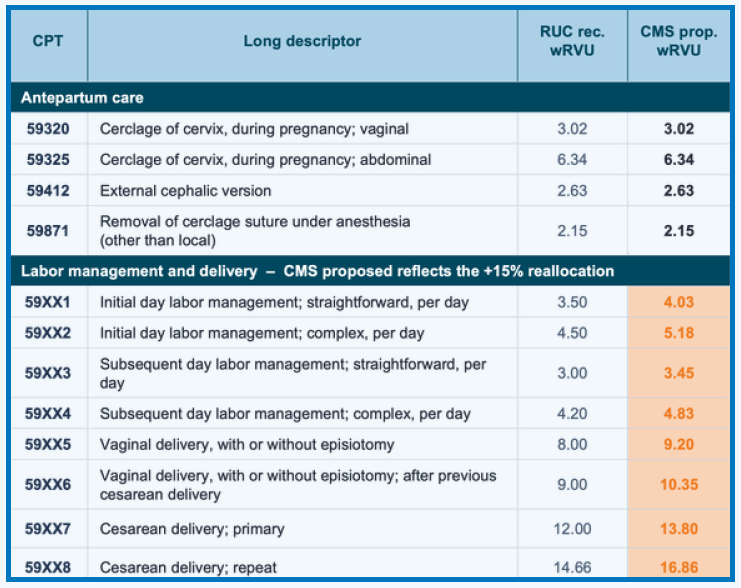
- CMS refinement: removes 4 prenatal E/M visits from the utilization estimate and reallocates wRVUs to the new labor & delivery codes – a +15% lift on each.
MAINTAIN TODAY’S STRUCTURE
- Keep the current coding and payment by creating new HCPCS G-codes in lieu of the new CPT codes.
- 15 new G-codes mirror the prior MMM global structure and preserve the global period and conditions of payment – calibrated to today’s global wRVUs.
How a Coding Restructure Became a Payment Question
At its January 2026 meeting, the RUC’s math revised the maternity global family – deleting 17 legacy CPT codes, creating 12 new codes, and revising 9 – moving from a bundled MMM global period toward individually reported services.
- MAY 2025: ACOG guidance
- SEPTEMBER 2025: AMA Endorses new CPT structure
- JANUARY 2026: RUC valuation
- JULY 2026: Proposed rule publishing
Why CMS is Weighing Two Very Different Approaches
The dispute is about a single assumption buried in the valuation: How many prenatal visits a typical pregnancy actually generates.
The Old Bundle
The MMM global (59400/59510/59610/59618) folded ~12 prenatal E/M visits into a single fixed payment, regardless of how many visits actually occurred.
The RUC’s Math
To keep the restructure budget neutral, the RUC still valued the new codes assuming all 12 prenatal visits would be reported (2 level-2, 8 level-3, 2 level-4).
CMS’s Concern
With ACOG now describing 8 visits as typical, assuming 12 overstates utilization – which overvalues antepartum work and undervalues the actual labor & delivery services.
Proposed wRVUs for Maternity Services
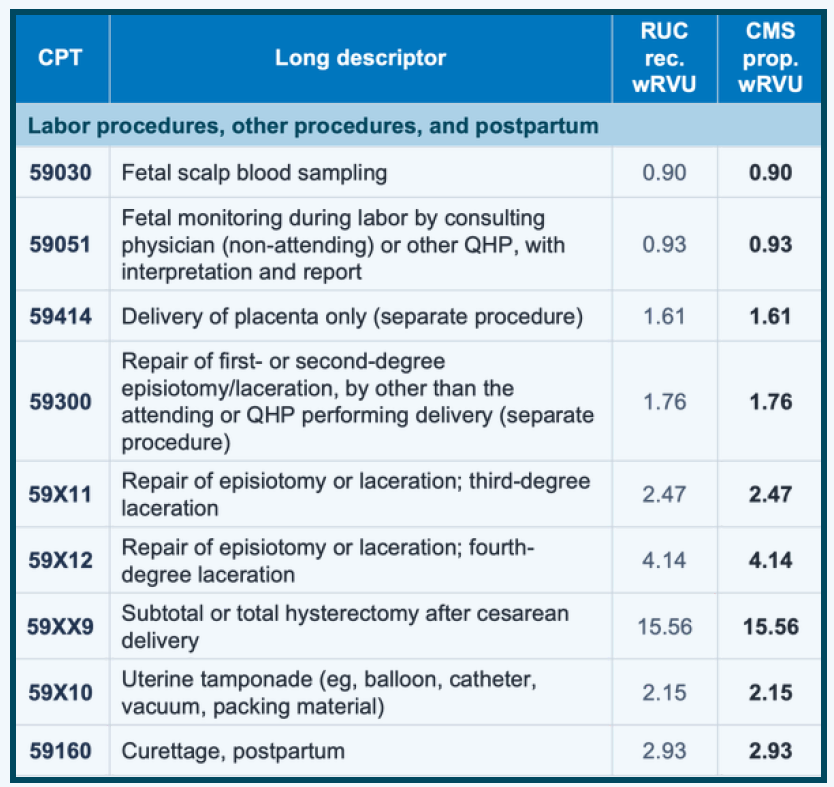
Labor Procedures, Other Procedures, and Postpartum
Compare and Contrast
What each option means where it counts.
| Comparison Area | Option A Adopt & Revalue | Option B Maintain via G-Codes |
|---|---|---|
| Provider Credit | Follows documented activity – each prenatal visit, labor day, and delivery earns its own wRVU. | Fixed per episode – the global bundle earns the same wRVU regardless of visit count. |
| Winners / Losers | Rewards labor & delivery (+15%); antepartum credit scales with actual visits (up for high-risk, down for low). | Neutral – preserves current relativities across antepartum, delivery, and postpartum. |
| Compensation Administration | Global-split attribution becomes largely unnecessary; component codes credit providers directly. | Existing wRVU-split methodologies for shared global care stay in place, unchanged. |
| Benchmarking / Fair Market Value | Historical global productivity no longer maps 1:1 – wRVU benchmarks and $/wRVU need recalibration. | Continuity preserved – survey benchmarks built on global codes remain comparable. |
| Operational Lift | Higher – EHR, charge capture, and coder workflows must shift to itemized reporting. | Lower – largely a code-set swap; workflows and global logic remain familiar. |
Implications for Physician Pay and Valuation
wRVU-Based Pay
Under Option A, wRVU credit becomes activity-based and tilts toward delivering physicians (the +15% L&D lift) and whoever renders each prenatal visit. Global-split attribution largely falls away.
Attribution Models
Option B preserves the need for wRVU-split methodologies across antepartum, delivery, and postpartum in shared-care and midwife-inclusive models. Option A credits components directly.
Benchmark Continuity
Survey benchmarks (e.g., SullivanCotter, MGMA) are built on historical global productivity. A shift to component coding can break wRVU comparability and $/wRVU calibration until data re-baselines.
Payer Ripple
Medicare is a minor OB payer, but commercial and Medicaid plans often track CMS structure. Watch downstream adoption before assuming the CMS choice is contained to Medicare.
Status and What to Watch
- NOVEMBER 2026 | CMS finalizes wRVUs and the chosen structure in the Final Rule.
- JANUARY 1, 2027 | Finalized coding and payment take effect for the calendar year.
Watch for final placeholder-to-real CPT number assignments, whether CMS chooses adoption vs. G-codes, the final labor & delivery values, and any commercial-payer signals on which structure they will follow.
Looking for more guidance on the changes?
SullivanCotter can help you navigate the potential impact!
Let’s connect >