Market Insights from SullivanCotter’s APP CPT Work RVU Benchmark Study
SullivanCotter’s CPT-based analysis of APP coding profiles reveals consistent wRVU differentials across practice settings for medical and surgical specialties.
This can impact how organizations utilize their APP workforce, structure incentive plans, and set productivity thresholds.
Establishing wRVU Thresholds
National Specialty Benchmark
Use when an APP’s role, deployment, and work setting are generally consistent across the specialty. In these cases, the national benchmark for that specialty is a strong fit for setting the threshold.
> Primary Care & Hospital-Based
APPs in primary care and hospital-based specialties predominantly practice within a single setting, so setting-based differentials are not applicable. Organizations can use specialtyspecific benchmarks, but other factors could be considered.
National Proxy Benchmark
Use when an APP’s role and deployment vary meaningfully by practice setting, making the specialty’s own benchmark a poor fit. Select a different specialty benchmark or apply a differential to the specialty benchmark that more closely reflects how the APP is deployed and where they practice.
> Inpatient (fewest wRVUs)
Magnitude varies by specialty group:
- Surgical specialties show wider differentials than medical
- Reflects a shift in APP roles from procedural to E&M-dominated coding
- Higher usage of split-shared and global billing
> Hybrid
In most specialties, hybrid APPs generate 20%–30% fewer wRVUs than outpatient peers – forming a consistent middle tier in the productivity hierarchy.
> Outpatient (most wRVUS)
In nearly every medical and surgical specialty, APPs working in predominantly outpatient settings consistently out-produce inpatient peers – driven by higher volumes of E&M and procedural visit coding.
Computed Benchmark
Use when an APP is in a unique role, or when the national specialty benchmark shows wide variation or limited consistency. Build the threshold from the APP’s actual CPT profile, using CPT benchmark data to guide the calculation.
> Unique/Variable Roles
APPs in unique program-specific roles, specialties with limited wRVU data, or first assist positions where scope and productivity vary too much for a standard benchmark or differential to apply can benefit from a computed benchmark.
Using CPT Study Results to Set Proxy Benchmarks
Apply these wRVU differentials to national survey benchmarks at the 50th percentile for the relevant specialty to establish setting-appropriate productivity thresholds. Note that this approach applies only to medical and surgical specialties; primary care and hospital-based specialties should instead use specialty-specific benchmarks directly. Regardless of which threshold or benchmark is set, care team dynamics and role context should always be considered.
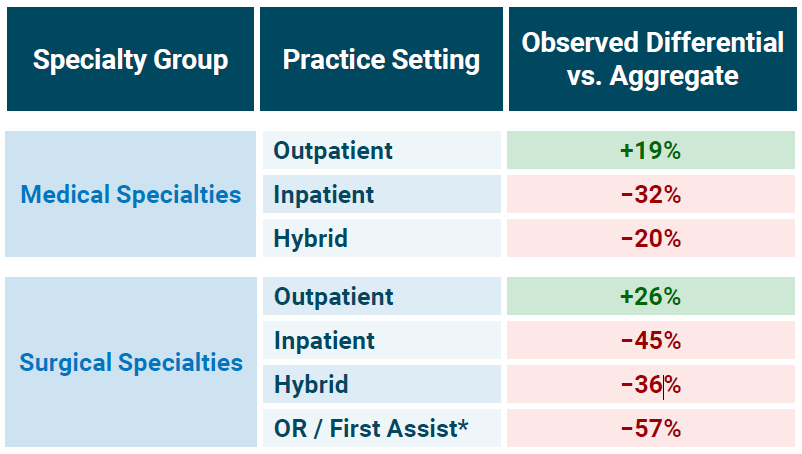
*OR/First Assist guidance of −57% applies as a general starting point for surgical specialties with lower aggregate benchmarks.
Note: Cardiothoracic Surgery, Neurological Surgery, and Cardiovascular Surgery APPs in OR roles are substantially more productive than the general -57% rule implies. These specialties warrant direct use of specialty-specific OR benchmarks.
Positive differentials in outpatient settings reflect higher E&M and procedural volume; negative differentials in inpatient, hybrid, and OR/First Assist settings reflect lower procedural coding and greater reliance on rounding, post-op E&M, and split-shared billing.
Considerations
- Differentials are based on CPT profile classification, not administrative designation — results reflect actual billing patterns.
- Sample sizes at the specialty level vary; specialty group guidance is more statistically robust than individual specialty estimates.
- Some specialties do not follow the same trends — Certified Nurse Midwives and APPs in Dermatology, Geriatrics, Infectious Disease, and Urgent Care show unique trends that warrant specialty-specific guidance and intentional care model design.
- Hybrid APPs do not uniformly represent a clean midpoint between inpatient and outpatient settings.
- The 70%+ threshold for setting classification creates boundary sensitivity — present adjustments as ranges, not point estimates.
- This data represents a range of care models and is directional in nature. Specific care models, team dynamics, and unique APP roles may not conform to this data and often require additional analysis and context.
- Practice setting is a meaningful driver of wRVU production. Using a single national benchmark without adjustment systematically misprices productivity expectations for non-outpatient APPs.
Ready to Apply These Insights at Your Organization?
Our team can help you evaluate your APP workforce by practice setting, apply the appropriate differentials to national benchmarks, and build wRVU thresholds and incentive structures that reflect how your APP care teams actually work — not just what the aggregate market shows.
Contact us to get started >