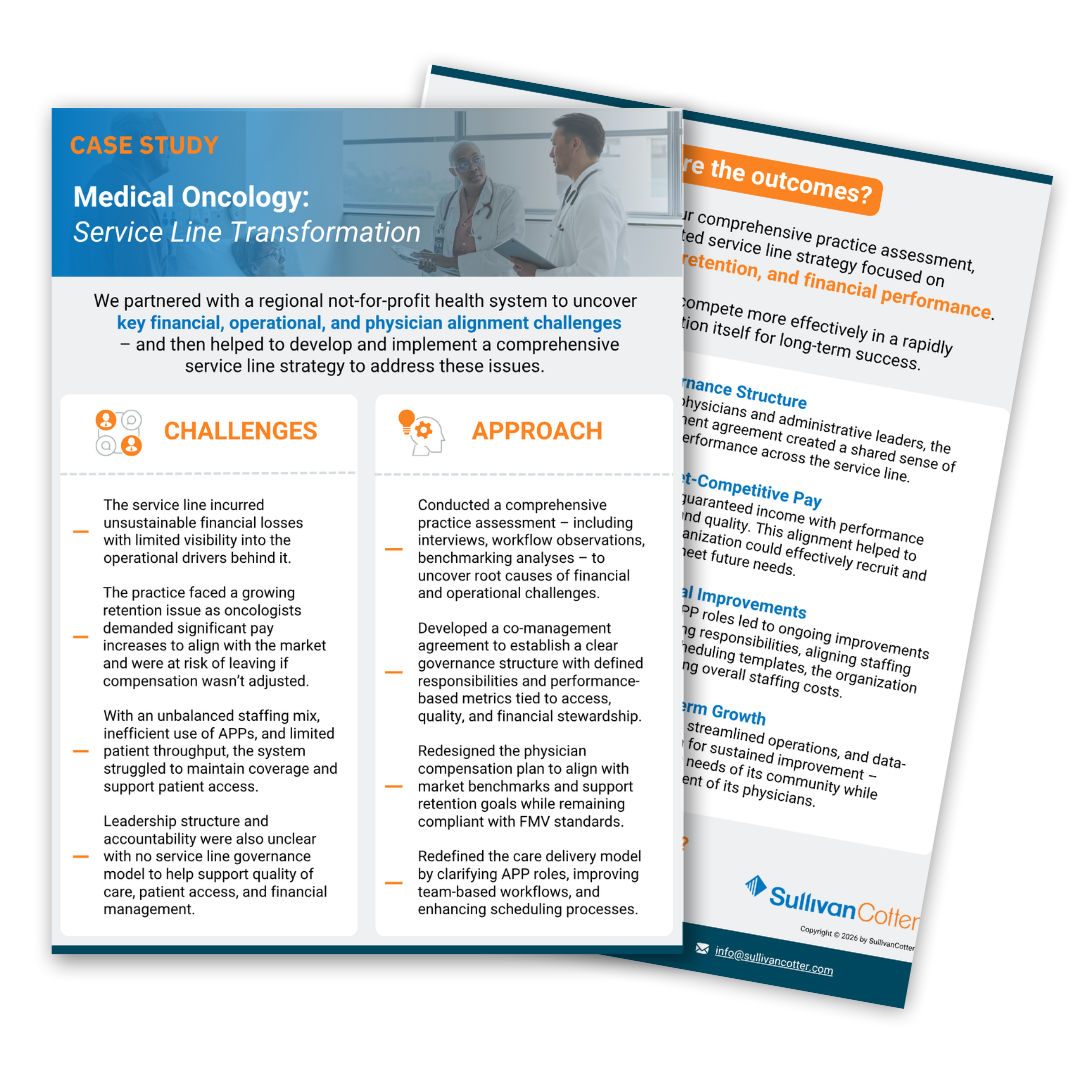
See how we partnered with a regional not-for-profit health system to uncover key financial, operational, and physician alignment challenges.
As health care organizations face increasing pressure to improve financial performance, enhance patient access, and retain key clinical talent, many medical oncology service lines are struggling to balance growth with operational sustainability. For one regional not-for-profit health system, these challenges had reached a critical point.
Faced with escalating losses, physician retention concerns, and an unclear governance structure, the organization partnered with SullivanCotter to develop a comprehensive service line transformation strategy. Through a combination of financial, operational, and physician alignment initiatives, the health system established a stronger foundation for long-term success.
Challenges
- The service line incurred unsustainable financial losses with limited visibility into the operational drivers behind it.
- The practice faced a growing retention issue as oncologists demanded significant pay increases to align with the market and were at risk of leaving if compensation wasn’t adjusted.
- With an unbalanced staffing mix, inefficient use of APPs, and limited patient throughput, the system struggled to maintain coverage and support patient access.
- Leadership structure and accountability were also unclear with no service line governance model to help support quality of care, patient access, and financial management.
Approach
- Conducted a comprehensive practice assessment – including interviews, workflow observations, benchmarking analyses – to uncover root causes of financial and operational challenges.
- Developed a co-management agreement to establish a clear governance structure with defined responsibilities and performance-based metrics tried to access, quality, and financial stewardship.
- Redesigned the physician compensation plan to align with market benchmarks and support retention goals while remaining compliant with FMV standards.
- Redefined the care delivery model by clarifying APP roles, improving team-based workflows, and enhancing scheduling processes.
Outcomes
Leveraging insights from our comprehensive practice assessment, we developed an integrated service line strategy focused on enhancing access, provider retention, and financial performance.
This enabled the system to compete more effectively in a rapidly growing market and position itself for long-term success.
- Formal Governance Structure: Strengthening collaboration between physicians and administrative leaders, the implementation of the new co-management agreement created a shared sense of ownership and responsibility for performance across the service line.
- Transparent, Market-Competitive Pay: The new compensation plan balanced guaranteed income with performance incentives tied to productivity, access and quality. This alignment helped to rebuild physician trust and ensure the organization could effectively recruit and retain oncologists to meet future needs.
- Measurable Operational Improvements: The care team redesign and optimization of APP roles led to ongoing improvements in patient throughput and access. By clarifying responsibilities, aligning staffing levels with clinical demand, and optimizing scheduling templates, the organization improved efficiency without increasing overall staffing costs.
- Positioned for Long-Term Growth: The combination of aligned physician incentives, streamlined operations, and data-driven management established a foundation for sustained improvement – enabling the organization to meet the evolving needs of its community while supporting the professional engagement of its physicians.